


Murder and Manslaughter (NSW)
Murder and Manslaughter (NSW)
Both murder and manslaughter are homicide offences — offences involving one person being unlawfully killed by another. This page outlines the laws surrounding murder and manslaughter in New South Wales, including the defences and penalties that apply.
The legislation
The laws surrounding murder and manslaughter in New South Wales are set out in the Crimes Act 1900.
Murder
Section 18 of the Crimes Act defines murder as causing another person’s death
- with reckless indifference to human life or
- with the intent to kill or inflict grievous bodily harm or
- in an attempt to commit a crime punishable by imprisonment for 25 years or more.
This definition of murder encompasses the situation where a person kills another person intentionally or recklessly as well as the situation where a person kills another person in the process of committing a serious offence punishable by more than 25 years imprisonment, such as rape or robbery.
Manslaughter
Under the common law, a fatal unlawful assault committed in any other circumstances is manslaughter. Manslaughter occurs when a person is unlawfully killed as a result of an intentional act in circumstances that do not meet the threshold for murder.
Penalties
The maximum sentence for murder is imprisonment for the term of the offender’s natural life. However, a lesser penalty than imprisonment for life can be imposed for murder.
The maximum penalty for manslaughter is imprisonment for 25 years.
Standard non-parole periods
When a person is sentenced for murder, the standard non-parole period that applies 20 years. In some situations, when a person is sentenced for murder, there is mandatory minimum sentence and/or a longer standard non-parole period that applies.
Murder of a police officer
When a a person is found guilty of murdering a police officer in the course of their duty or as a consequence of or in retaliation for something they have done in the course of their duty, the court must give reasons if it departs from the standard non-parole period of 20 years.
Murder of a child
When a person is found guilty of murdering a child under 18, the standard non-parole period that applies is 25 years. If a court imposes a shorter non-parole period, it must give reasons.
Murder of an intimate partner
Under section 21A of the Crimes (Sentencing Procedure) Act 1999, when a person is found guilty of murdering an intimate partner, the standard non-parole period that applies is 25 years. If a court imposes a shorter non-parole period, it must give reasons.
Defences
The most common defences that apply to the offences of murder and manslaughter are outlined below.
Extreme provocation
In New South Wales extreme provocation is a partial defence to murder. If a person charged with murder is found to have killed the deceased in response to extreme provocation, they will be found guilty of manslaughter rather than murder if:
- the accused’s act was in response to conduct of the deceased;
- the conduct of the deceased was a serious indictable offence;
- the conduct of the deceased caused the accused to lose self-control;
- the conduct of the deceased could have caused an ordinary person to lose self-control to the extent of intending to kill or cause grievous bodily harm.
It is important to note that conduct is not extreme provocation if it is limited to a non-violent sexual advance.
Self-defence
A person is not guilty of murder or manslaughter if they killed in self-defence. This is because the law recognises that a person has the right to act in self-defence when faced with a physical attack or threatened attack. Self-defence includes defence of another person.
When a defendant raises the defence of self-defence, it is up to the prosecution to prove beyond a reasonable doubt that the accused was not acting in self-defence. If the prosecution cannot prove this, the accused must be found not guilty.
For the defence of self-defence to succeed, the accused must have had a reasonable belief that it was necessary to do what he or she did in self-defence. Whether the accused’s actions were reasonable in self-defence will depend on the extent of the threat that was faced.
Duress
A defence to manslaughter is that the accused was acting under duress. A person acts under duress when their actions are performed because of threats of death or really serious injury that would cause a person of ordinary courage to yield.
If the defence raises the defence of duress, the prosecution bears the burden of proving that the accused was not acting under duress.
Other defences that may be advanced in relation to a manslaughter charge are: automatism and involuntary intoxication.
Other homicide offences
If a woman kills her baby (aged under twelve months) because the balance of her mind is disturbed as a result of giving birth to the child, she can be found guilty of infanticide. This offence can be charged as an alternative to manslaughter and carries the same penalty as manslaughter.
Section 25A of the Crimes Act makes it an offence, punishable by imprisonment for up to 20 years, to assault another person by hitting them, causing the death of the other person. This is known as ‘one punch manslaughter.’
Which court will hear the matter?
Charges of murder and manslaughter are indictable offences, which can only be heard by the District Court or Supreme Court.
If you need legal advice on a criminal law matter or any other legal matter please contact Go To Court Lawyers.

Fernanda Dahlstrom is a writer, editor and lawyer. She holds a Bachelor of Laws (Latrobe University), a Graduate Diploma in Legal Practice (College of Law), a Bachelor of Arts (The University of Melbourne) and a Master of Arts (Deakin University). Fernanda practised law for eight years, working in criminal law, child protection and domestic violence law in the Northern Territory, and in family law in Queensland.
Related Content












Michelle Makela
Legal Practice Director
Michelle Makela has almost two decades of industry experience, coupled with a diverse academic background, and is committed to understanding the human side of law. Michelle holds a Juris Doctor, a Bachelor of Science (Psychology), and a Master of Criminology. She was admitted to legal practice in 2006. Over 19 years, Michelle has gained experience in commercial litigation, criminal law, family law, and estate planning. Her multidisciplinary background enables her to approach complex legal challenges strategically, compassionately and with an awareness of the big picture. Michelle leads the firm with integrity, sharp legal acumen, and dedication to delivering positive client experiences.

Affordable Lawyers
Our Go To Court Lawyers will assist you in all areas of law. We specialise in providing legal advice urgently – at the time when you need it most. If you need a lawyer right now, today, we can help you – no matter where you are in Australia.How It Works




1. You speak directly to a lawyer
When you call the Go To Court Legal Hotline, you will be connected directly to a lawyer, every time.
2. Get your legal situation assessed
We determine the best way forward in your legal matter, free of charge. If you want to go ahead and book a face-to-face appointment, we will connect you with a specialist in your local area.
3. We arrange everything as needed
If you want to go ahead and book a fact-to-face appointment, we will connect you with a specialist in your local area no matter where you are and even at very short notice.
Related Law Topics

Summary Offences in South Australia
Summary Offences in South Australia Criminal offences are dealt with differently by the courts depending on whether they are summary or indictable offences. Summary offences are minor offences that can only be finalised in the lower courts (that is, the Magistrates Court and Children’s Court). Summary offences include traffic offences, ....
Posted in:
Offences

One Punch Assaults Causing Death (NSW)
One Punch Assaults Causing Death (NSW) One punch assaults, also known as ‘king hits’ or ‘coward punches’, have dominated the media in recent years. These terms refer to assaults where a person strikes another in the head and knocks them unconscious, leaving the victim at risk of further head trauma when impacting ....
Posted in:
Offences

Strangulation Offences (NSW) All Australian states and territories now have legislation that makes non-fatal strangulation a standalone offence. This means that when an assault that involves strangulation is committed, it can be charged as a strangulation offence rather than simply as an assault. Strangulation offences carry much higher maximum penalties ....
Posted in:
Offences
Fraud in the Australian Capital Territory
Fraud in the Australian Capital Territory Fraud in the Australian Capital Territory is dealt with under Part 3.3 of the Criminal Code 2002. This part of the Code covers a range of fraud-based offences including obtaining property by deception under section 326, obtaining financial advantage by deception under section 332, ....
Posted in:
Offences

Offences Relating to Protests (NSW)
Offences Relating to Protests (NSW) The right to freedom of political expression, including peaceful protests, is protected under the Australian constitution. A person cannot be charged with taking part in a political protest. However, there are a number of offences that can arise out of participation in protests if certain ....
Posted in:
Offences

The offence of fraud is governed by section 408C of the Queensland Criminal Code 1899. That provision states that a person commits fraud if they dishonestly: Apply to their own use or to the use of another person property belonging to another or property in the person’s possession that is subject ....
Posted in:
Offences

Assault Charges in Western Australia
Assault Charges in Western Australia Assault charges in WA are dealt with under Part 5 of the Criminal Code 1913 (WA). The circumstances of an assault and the degree of harm inflicted will determine the charge that is laid and whether the matter is dealt with by a magistrate or in a ....
Posted in:
Offences

Offences Involving Underage Drinking (Qld)
The age at which a person can legally drink alcohol in Queensland is 18. There are numerous criminal offences that relate to supplying alcohol to a minor or allowing a minor to be on licensed premises or to possess or consume alcohol. These offences can attract fines of up to ....
Posted in:
Offences
Family Violence Orders in Tasmania
Family Violence Orders in Tasmania (FVO) are orders that imposes conditions on a person’s behaviour to try to prevent future family violence. The laws that relate to the process of applying for family violence orders in Tasmania are the Family Violence Act 2004 and the Justices Amendment (Family Violence) Rules 2005. Family Violence ....
Posted in:
Restraining Orders
Offences
Intentionally or Recklessly Causing Injury (Vic)
Intentionally or Recklessly Causing Injury (Vic) The Victorian Crimes Act contains several offences relating to causing injury intentionally or recklessly. These are serious offences that can attract lengthy terms of imprisonment, with a mandatory minimum sentence applying in some circumstances. This page outlines these offences and the penalties that apply. ....
Posted in:
Offences
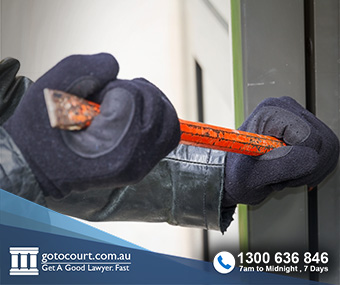
Burglary in Brisbane and elsewhere in Queensland is the offence of entering or being in the dwelling of another with the intent of committing a crime. It is governed by section 419 of the Criminal Code 1899 and can attract a penalty of up to 14 years imprisonment. Longer maximum ....
Posted in:
Offences

Indictable Offences in Melbourne
Indictable Offences in Melbourne Criminal offences in Melbourne and the rest of Victoria are dealt with differently depending on whether they are summary offences, indictable offences or strictly indictable offences. A summary offence is a minor offence that is dealt with summarily, meaning it is finalised by a Magistrate, either ....
Posted in:
Offences